 भारत सरकार | Government of India


NKN is a hierarchical network divided into three basic layers - Core (Level 1), Distribution (Level 2), and Edge (User Level). Depending on the type of connectivity required by the user organization, geographical presence, and the location of Points of Presence (PoP) of NKN, connectivity would be provided to the institutes. The NKN backbone will typically have 18 Core PoPs and around 25 Distribution PoPs across the country.
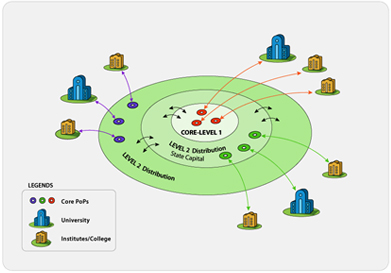
The NKN design uses a consortium of bandwidth providers for realising NKN since no single vendor has the geographical spread necessary for creating a pan-India network and connecting underserved areas. The NKN backbone will be created by multiple bandwidth providers and the edges can be provided by any service provider, if the interface and feature set are in conformance with NKN design.
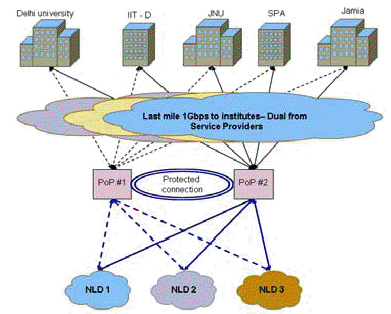
The Core PoPs will be connected as per Figure 2. Distribution PoPs can connect to different Core PoPs using links from different National Long Distance service providers (NLDs), and form the NKN Backbone. Each of the Core PoPs will have last mile from a different NLD, ensuring high availability at the PoP level.
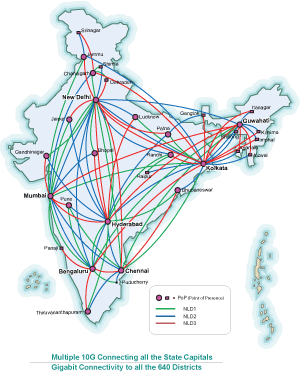
These PoPs shall be interconnected using multiple links from different NLDs to form a Mesh network. Another design parameter considered is to keep the maximum number of hops between any two PoPs under 4–5.
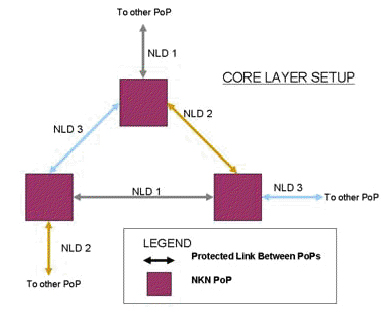
Apart from using λs from existing NLDs, the four legacy metros (New Delhi, Mumbai, Chennai & Kolkata) will also be connected using Dark Optical Fibre to further boost data transfer capacity.
From the NKN PoPs, end user institutions are directly connected. These connections are referred to as Edge connectivity or the Last Mile. In cities with multiple PoPs, high-availability design ensures that institutes can connect to different NLDs via redundant links.
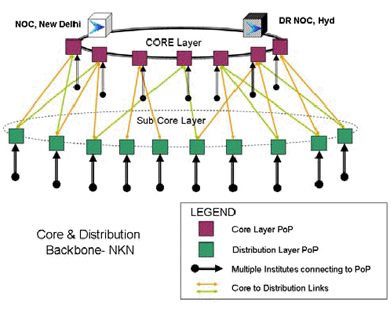
The end user institutions will have the option to operate at speeds ranging from 100 Mbps – 1 Gbps per connection, preferably on protected links for resilience.
NKN ensures not just connectivity, but also multiple choices for running services, enabling innovation and reliable delivery of applications across the nation.


